MMG Database
New Database Added: MMGDB (March 4, 2016, midnight)
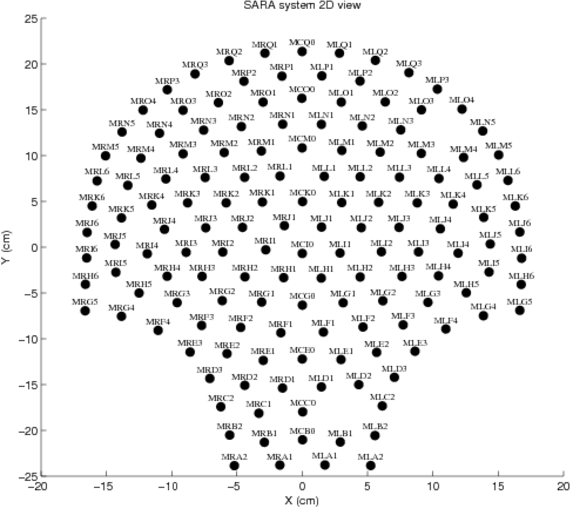
The MMG Database contains uterine magnetomyographic (MMG) signals recorded using the 151 channel SARA (SQUID Array for Reproductive Assessment) system installed at UAMS, Little Rock, USA.
D. Escalona-Vargas, R.B. Govindan, A. Furdea, P. Murphy, C. L. Lowery, and H. Eswaran. Characterizing the Propagation of Uterine Electrophysiological Signals Recorded with a Multi-Sensor Abdominal Array in Term Pregnancies. PLoS ONE, 10(10), 2015. http://www.ncbi.nlm.nih.gov/pmc/articles/PMC4624716/
Pollard, T., Moody, B. E., Lehman, L., Gow, B., Fernandes, C., Xie, C., Johnson, A., Mark, R. G., & Heldt, T. (2026). PhysioNet as a global platform for biomedical research. Nature Health. https://doi.org/10.1038/s44360-026-00096-z. Available from: https://rdcu.be/faatM
Abstract
This database contains uterine magnetomyographic (MMG) signals recorded using the 151 channel SARA (SQUID Array for Reproductive Assessment) system installed at UAMS, Little Rock, USA. Recordings are taken from 25 subjects who presented themselves in the Triage unit of Labor and Delivery and were undergoing monitoring and evaluation of labor. All subjects were asked to lean forward and sit comfortably with the sensor array covering their pregnant abdomens. The duration of a recording was typically around 20 minutes.
Data Description
To obtain the final MMG signals, the original 250Hz data was downsampled to 32 Hz, bandpass filtered (0.1-1 Hz) to attenuate the maternal and fetal cardiac signals, and notch filtered (0.25-0.35 Hz) to suppress the prominent maternal breathing around 0.33 Hz. Furthermore, segments with maternal movement were excluded. Each final recording in this database contains 147 to 148 channels and lasts between 10 and 20 minutes.
The data was preprocessed in MATLAB and converted to WFDB format using the mat2wfdb function from the PhysioToolkit software. File names in the database are of the form ###_*GA, where ### is the ID of the participant, and *GA refers to gestational age in weeks and days (ie. 38w0d). Header files contain channel labels and the following clinical information:
- Cervical dilation (dilation cm)/(effacement %)/(station)
- Days to delivery after SARA recording.
- Race
- BMI
- Gestation Period (weeks+days)
The sensorpositions record contains x, y, and z coordinates of the SARA array's 149 different channels present in the database. Refer to SARAarray.eps or SARAarray.tif for diagrams of the apparatus.
Relevant Publications
- H. Eswaran, H. Preissl, J. D. Wilson, P. Murphy, C. L. Lowery. Prediction of labor in term and preterm pregnancies using non-invasive magnetomyographic recordings of uterine contractions. Am J Obstet Gynecol, 190(6), pp. 1598-1602, 2004.
- H. Eswaran, H. Preissl, J. D. Wilson, P. Murphy, S. E. Robinson,C. L. Lowery. First magnetomyographic recordings of uterine activity with spatial-temporal information with a 151-channel sensor array. Am J Obstet Gynecol, 187(1), pp. 145-151, 2002.
Cited by
2 publications cite this project. The most recent are listed below.
-
Towards an affordable magnetomyography instrumentation and low model complexity approach for labour imminency prediction using a novel multiresolution analysis
Ejay Nsugbe, Ibrahim Sanusi. Applied AI Letters, 2021. -
A Low Channel Number Sensing Approach for an Ethnic Specific Labour Immanency Prediction using Bio-Electromagnetism
Ejay Nsugbe, Ibrahim Sanusi, Olusayo Obajemu et al. IEEE International Workshop on Metrology for Industry 4.0 & IoT (MetroInd4.0&IoT), 2021.
Citation data from OpenAlex. Papers that use the project without citing it may be missing.
Files
Total uncompressed size: 215.7 MB.
Access the files
- Download the ZIP file (215.7 MB)
-
Download with the PhysioNet Python package:
physionet download mmgdb --version 1.0.0
-
Download the files using your terminal:
wget -r -N -c -np https://physionet.org/files/mmgdb/1.0.0/
- To download the files using AWS command line tools, first configure your AWS credentials.